Industrial facilities today are more connected, automated, and data-driven than ever before. Behind every efficient production line, reliable utility system, and safe processing environment is a carefully designed framework of Operational Technology (OT). For plant managers and facility owners, understanding how OT works is no longer optional it is essential for uptime, safety, and long-term operational resilience.
This guide explains what Operational Technology in industrial facilities is, how it functions, and how Atlas OT supports modern plants with purpose-built OT solutions.
What Is Operational Technology in Industrial Facilities?
Operational Technology refers to the hardware and software systems used to monitor, control, and automate physical processes inside industrial environments. Unlike traditional IT systems that manage data and business applications, OT interacts directly with machines, equipment, and infrastructure.
In industrial facilities, Operational Technology is responsible for:
- Keeping production lines running consistently
- Monitoring real-time performance
- Supporting safety conditions
- Automating repetitive or precision-based tasks
- Preventing costly downtime and operational failures
OT environments are designed for reliability and determinism. A delay of even milliseconds can disrupt operations, damage equipment, or compromise safety. That is why OT systems are engineered differently from office IT networks.
At Atlas OT, Operational Technology is approached as a complete ecosystem integrating control hardware, automation networks, and secure system design to support industrial reliability. You can learn more about Atlas OT’s approach to industrial automation and OT infrastructure.
Core Components of Operational Technology Systems
Operational Technology in industrial facilities is built from multiple interconnected components, each playing a specific role in controlling and monitoring physical processes.
Industrial Control Systems (ICS)
Industrial control systems are the foundation of OT environments. These systems coordinate how machines respond to inputs, alarms, and process changes.
Key characteristics of industrial control systems include:
- Continuous operation in harsh environments
- Deterministic response times
- High availability and fault tolerance
ICS form the backbone of manufacturing plants, utilities, and processing facilities where consistent control is critical.
PLC and SCADA Environment
A modern PLC SCADA environment brings intelligence and visibility into industrial operations.
- PLCs (Programmable Logic Controllers) execute control logic that governs machines and processes.
- SCADA systems provide operators with centralized monitoring, alarms, and control interfaces.
Together, they allow plant teams to see what is happening in real time and respond quickly to abnormal conditions. We design and integrate PLC and SCADA systems that align with the specific operational requirements of each facility, ensuring reliability without unnecessary complexity.
Field Devices and Instrumentation
Field devices are the physical touchpoints between OT systems and real-world processes.
Examples include:
- Sensors measuring temperature, pressure, flow, or level
- Actuators controlling valves, motors, and drives
- Safety devices that trigger shutdowns when limits are exceeded
These field devices generate the data that drives automation decisions. Proper selection, wiring, and integration of field devices are essential for accurate process control an area where Atlas OT provides hands-on engineering support.
OT Systems Examples in Modern Industrial Facilities
Operational Technology looks different depending on the industry, but the core principles remain the same. Below are practical OT systems examples commonly found in modern facilities.
Manufacturing and Processing Plants
In manufacturing environments, OT systems control:
- Production lines and batch processes
- Quality monitoring and defect detection
- Equipment synchronization and material flow
Automation reduces human error and improves consistency, especially in high-volume or precision-driven operations.
Food Industry OT Environments
Food processing facilities require strict control over hygiene, temperature, and timing. Atlas OT has specific expertise in food industry Operational Technology, where systems must balance productivity with regulatory compliance.
Utilities and Infrastructure
In utilities, OT systems manage:
- Pumping and distribution systems
- Water and wastewater treatment processes
- Power monitoring and load control
These systems must operate continuously and safely, often with limited on-site staffing.
How Operational Technology Is Used in Modern Industrial Facilities
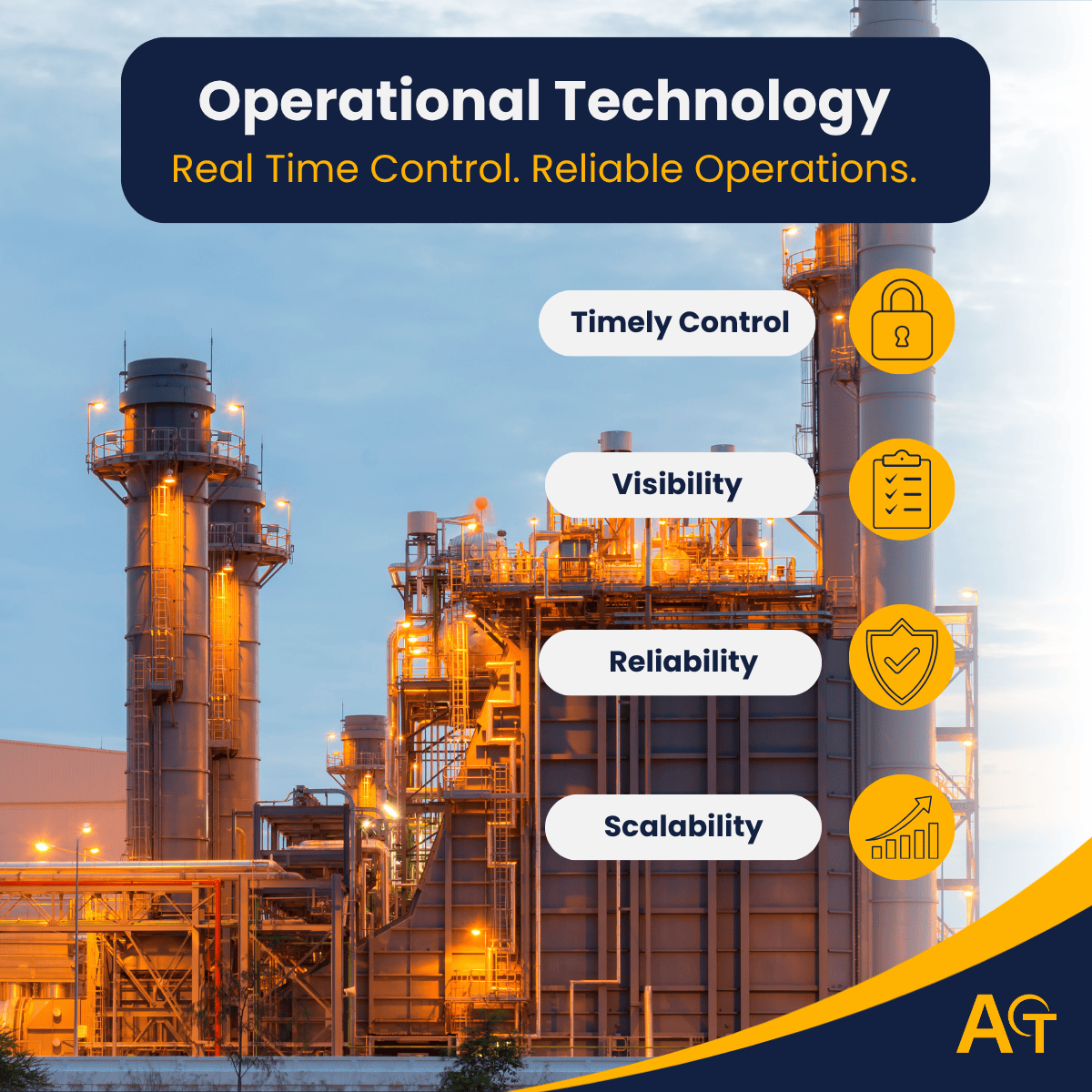
Operational Technology plays a direct role in how facilities operate day to day. Its value lies in real-time control, automation, and decision support.
Automation Networks and Connectivity
Automation networks connect PLCs, SCADA systems, and field devices into a unified control architecture. These networks are designed for:
- Low latency communication
- High reliability
- Segmentation between control layers
Our engineers' automation networks that support current operational needs while allowing room for future expansion.
Real-Time Monitoring and Control
OT systems provide continuous insight into:
- Equipment status
- Process variables
- Alarm conditions
Operators can make informed decisions quickly, reducing downtime and preventing small issues from becoming major failures.
Safety and Compliance Support
Operational Technology supports safety systems by:
- Enforcing process limits
- Triggering emergency shutdowns
- Logging events for audits and compliance
Well-designed OT systems help facilities meet regulatory requirements while protecting personnel and assets.
Benefits of Strong Operational Technology Implementation
When Operational Technology is properly designed and maintained, facilities experience measurable benefits.
Key advantages include:
- Improved uptime and production stability
- Reduced manual intervention and error
- Better visibility into operational performance
- Enhanced safety and risk management
- Support for modernization and digital initiatives
We focus on delivering OT solutions that are practical, maintainable, and aligned with real-world plant operations not just theoretical designs.
Common Challenges in OT Environments
Despite its benefits, Operational Technology presents unique challenges for plant managers and facility owners.
Legacy Systems and Integration
Many facilities rely on older control systems that were never designed for modern connectivity. Integrating new automation with legacy equipment requires careful planning to avoid disruptions.
Network and System Complexity
As facilities grow, OT architectures can become fragmented. Without clear design standards, automation networks can be difficult to manage and troubleshoot.
Security and Reliability Balance
OT systems must remain secure without sacrificing availability. Changes must be carefully tested, as downtime directly impacts operations.
We address these challenges by designing systems that prioritize operational reliability while supporting secure, scalable growth.
How Atlas OT Supports Modern Industrial Facilities
We provide end-to-end Operational Technology services tailored to industrial environments.
Core capabilities include:
- OT system design and architecture
- PLC and SCADA integration
- Electrical and control panel engineering
- Automation network design and implementation
- Support for industry-specific OT requirements
Our electrical and control panel solutions are a critical part of reliable OT infrastructure.
Rather than offering one-size-fits-all solutions, Atlas OT works closely with facility teams to understand operational goals and constraints.
Best Practices for Managing Operational Technology
To maximize the value of OT systems, plant managers should focus on:
- Aligning OT design with operational priorities
- Maintaining clear documentation and standards
- Planning for lifecycle management and upgrades
- Partnering with experienced OT specialists
A proactive approach to Operational Technology reduces risk and supports long-term performance.
Conclusion: Building Reliable Industrial Operations with Operational Technology
Understanding what Operational Technology in industrial facilities is is the first step toward building safer, more efficient, and more resilient operations. OT systems bring together industrial control systems, PLC SCADA environments, field devices, and automation networks into a cohesive framework that supports modern industry.
Atlas OT helps facilities design, implement, and maintain Operational Technology that works in real-world conditions not just on paper. Whether you are modernizing an existing plant or planning new automation, expert OT support makes a measurable difference.