In the world of Operational Technology (OT), industrial control systems are the central nervous system of critical infrastructure, manufacturing, and municipal utilities. For decades, Supervisory Control and Data Acquisition (SCADA) systems have been designed, integrated, and maintained using a fragmented mix of proprietary vendor guidelines, tribal knowledge, and ad-hoc engineering practices.
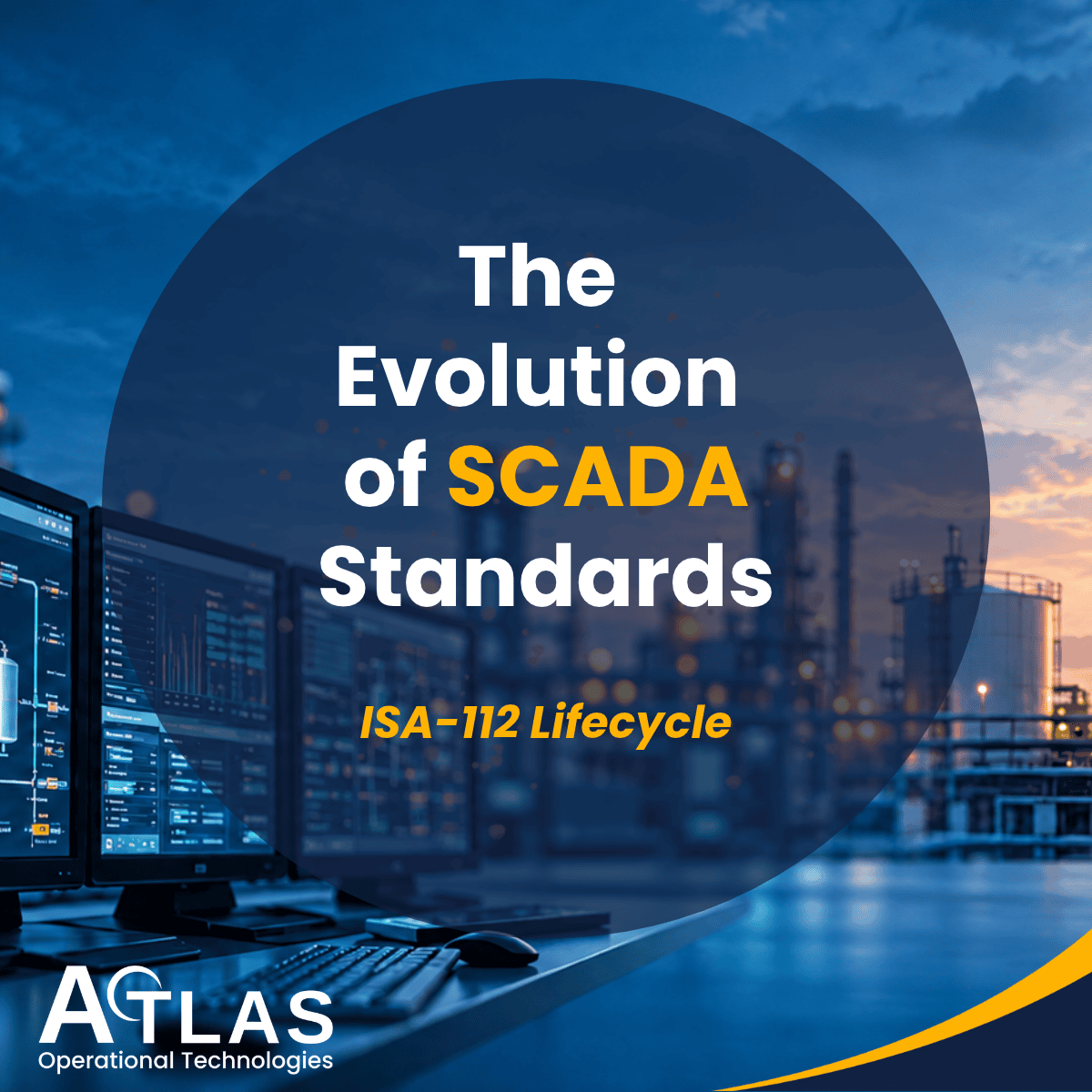
The release of ANSI/ISA-112.00.01-2025, SCADA Systems – Part 1: SCADA Lifecycle, Diagrams and Terminology mark a watershed moment for the automation industry.
The ISA112 Committee, comprising end-users, vendors, and integrators from municipal water, oil and gas, manufacturing, and mining—spent nearly a decade of developing this framework. The result is a unified, vendor-neutral standard that governs the long-term planning, design, implementation, and maintenance of SCADA systems to ensure their absolute integrity and reliability.
At Atlas OT, we design, build, and secure industrial automation systems that stand the test of time. Whether we are fabricating an NNNY-listed UL 508A/UL 698A control panel or hardening a municipal water treatment network against cyber threats, we build strictly to standard. This pillar page is your definitive guide to understanding ISA-112, why it was created, and how it reduces operational risks, lowers project costs, and guarantees future-proof compliance.
The Evolution of SCADA: Why We Needed a Standard
To understand the immense value of ANSI/ISA-112.00.01-2025, we must first look at how SCADA systems have evolved and why the lack of a universal standard historically plagued the industry with bloated costs and severe cybersecurity vulnerabilities.
According to the ISA-112 standard, SCADA evolution is categorized into distinct generations:
- First-Generation (Monolithic): Popularized in the 1970s, these systems utilized expensive, manually operated mainframe computers. Because network services were not readily available, these systems were completely isolated from silos, unable to easily share information with other facility systems.
- Second-Generation (Distributed): These systems distributed information and command processing across multiple stations using local area network (LAN) and wide area network (WAN) connectivity. While cost-effective, communication protocols remained highly complex and proprietary. Vendors actively created "walled gardens" to lock end-users into their hardware ecosystem.
- Third-Generation (Networked): The lines between SCADA and Distributed Control System (DCS) technologies blurred. Standard internet protocols enable communication between multiple vendors. Server technology provided a single supervisor and historian to support multiple systems across a WAN.
- Current Generation (Cloud & IIoT): Modern SCADA systems incorporate virtual, web, or cloud-based servers. Users can securely view data, exchange information between vendor equipment, and control processes from anywhere in the world via mobile applications and web browsers.
The Problem: While technology advanced rapidly, the management of these systems did not. Without a unifying framework, facility managers routinely faced proprietary lock-in, misaligned terminology, poor technical documentation, and architectures that were impossible to secure under modern frameworks like IEC 62443. ISA-112 was created to bring order to this chaos.
Defining "SCADA": The Company A vs. Company E Dilemma
One of the greatest hurdles the ISA112 committee faced was that there is no universally agreed-upon definition of what components actually constitute a "SCADA system." The definition varies wildly depending on the industry, geographic area, government regulations, and an end-user’s internal history.
The standard brilliant addresses this by establishing a framework that is adaptable to various organizational definitions, illustrated through several examples:
Organization Type | Definition of the "SCADA System" | How ISA-112 Applies |
Company A (Manufacturing) | Defines SCADA as only the "higher-level" software (Servers, Historians, View Terminals) that monitors existing, standalone machinery. | Focuses heavily on the upper architecture layers (Enterprise/Supervisory) and software lifecycle management. |
Company B (Upstream Oil & Gas) | Defines SCADA strictly as the WAN and backhaul communication elements connecting remote wellheads and pipelines to a central hub. | Focuses on the networking, telemetry, and remote connectivity standards within the framework. |
Company E (Municipal Water/Wastewater) | Uses a "whole control system" definition. Everything from the central servers down to the PLCs, UL 508A panels, and physical field wiring is considered SCADA. | Utilizes all elements of the ISA-112 standard, integrating physical fabrication, local control, and enterprise management. |
The 8-Group SCADA Lifecycle Framework
A SCADA system is not a one-time construction project; it is a living entity that requires continuous management over a lifespan of 15 to 20 years. ISA-112 moves the industry away from short-sighted project execution and towards holistic lifecycle management, organizing activities into eight distinct groups.
The Sequential Work Processes (Project Execution)
These phases represent the traditional timeline of bringing a new SCADA system (or a major upgrade) online:
Group 1: System Definition and Justification
Long before a control panel is fabricated, the lifecycle demands rigorous planning. This includes developing the overarching SCADA philosophy, performing initial feasibility studies, and defining User Requirement Specifications (URS).
Group 2: Design and Engineering
This is where the conceptual becomes concrete. The design phase requires highly structured documentation, including architecture design, hardware/software specifications, and network topologies.
Atlas OT Integration: During this phase, we specify the exact UL 508A and UL 698A (Hazardous Locations) requirements for custom control panels to ensure AHJ approval and physical safety.
Group 3: Implementation, Development, and Testing
The execution phase. This involves programming the PLCs, configuring HMI screens, and building the network. Crucially, it mandates rigorous testing, including Software Factory Acceptance Testing (SW-FAT) and Hardware Factory Acceptance Testing (FAT), performed in a controlled environment before shipping to the site.
Group 4: Installation and Commissioning
Installing the system at the client's facility. This includes Site Acceptance Testing (SAT), System Integration Testing (SIT), loop checks, and formal handover protocols from the integrator to the operations team.
Group 5: Operations and Maintenance (O&M)
The longest phase of the lifecycle. It focuses on day-to-day operations, alarm management, routine hardware maintenance, and performance monitoring to ensure the system delivers optimal Total Cost of Ownership (TCO).
Group 6: Decommissioning and Modernization
Eventually, legacy hardware reaches the end of its life. ISA-112 defines safe, structured processes for retiring old systems, securely destroying sensitive data, and cutting over to modernized architectures without causing catastrophic plant downtime.
The Continuous Work Processes (Governance)
Wrapped around the sequential project phases are two groups of activities that never stop:
Group 7: Continuous SCADA Management
This governs the administrative lifecycle. It includes long-term strategic planning, rigorous Management of Change (MoC) tracking, version and configuration control, and periodic system audits. If a change is made to PLC logic at 2 AM on a Sunday, MoC processes ensure it is documented, reviewed, and archived.
Group 8: Continuous Cybersecurity & Safety
Security is not a phase; it is a posture. Cyber-informed engineering, incident response planning, and risk assessments must be actively managed at every step of the lifecycle to align with modern threat landscapes.
The 11-Layer SCADA Reference Architecture
Historically, if you asked three different systems integrators to draw your plant’s network, you would get three completely different, highly customized drawings. This lack of standardization led to massive confusion during troubleshooting and made accurate project bidding nearly impossible.
Part 1 of the ISA-112 standard introduces a standardized 11-layer reference architecture (Layers A through K). This model categorizes assets logically from the physical plant floor up to the corporate cloud.
Breakdown of the 11 Layers:
- The Enterprise / Cloud Level (Layers A - C):
- Layer A (Cloud/External): Remote access portals, third-party analytics, and external IIoT integrations.
- Layer B (Enterprise Business): ERP systems, corporate IT networks, and business-level data historians.
- Layer C (Enterprise SCADA DMZ): The critical buffer zone between the business network and the industrial network, housing read-only data servers and patch management servers.
- The Supervisory / SCADA Level (Layers D - F):
- Layer D (Supervisory Control): The main automation servers, primary data historians, and central alarming servers.
- Layer E (Supervisory Network): The core LAN/WAN infrastructure routing traffic between the servers and the plant floor.
- Layer F (HMI / View Nodes): The central control room operator workstations and large visualization screens.
- The Control Level (Layers G - I):
- Layer G (Control Network): The localized network switching on the plant floor.
- Layer H (Local Control): This is the physical brains of the operation. It includes the PLCs, RTUs, and Edge Controllers.
- Layer I (Local HMI): Touchscreens mounted directly on the machinery or panel doors for localized operator control.
- Atlas OT Integration: Layers G, H, and I are the primary components housed within our NNNY-listed custom control panels.
- The Field Level (Layers J - K):
- Layer J (Field Network/Wiring): The physical I/O wiring, proprietary fieldbus networks, and intrinsic safety barriers (critical for UL 698A compliance).
- Layer K (Field Devices): The physical sensors, actuators, transmitters, pumps, and motors.
By enforcing this 11-layer model, ISA-112 ensures that new engineers or third-party integrators can instantly read and understand a facility's data flow, drastically reducing downtime during emergency troubleshooting.
Security Alignment: ISA-112, IEC 62443, and Federal Directives
It is impossible to discuss modern SCADA without addressing cybersecurity. The brilliance of the ISA-112 framework is that it is built to interface flawlessly with the world’s leading security and regulatory standards.
Enabling the ISA/IEC 62443 "Zones and Conduits" Model
ISA/IEC 62443 is the premier global standard for securing Industrial Automation and Control Systems (IACS). It relies entirely on segmenting networks into secure physical and logical "Zones" and controlling data traffic through heavily restricted "Conduits" (firewalls).
You cannot define a Zone or a Conduit if you do not have an accurate network architecture diagram. The 11-layer architecture defined by ISA-112 provides the exact blueprint required. By aligning architectural layers with functional zones, integrators can precisely place Demilitarized Zones (DMZs), dictate firewall rules, and establish secure remote access pathways that strictly adhere to IEC 62443 parameters.
Fulfilling NIST SP 800-82 and Municipal Compliance (CISA/CIRSA)
For municipal clients, particularly in water, wastewater, and public power, adhering to strict federal and state guidelines is tied directly to funding and liability protection.
- NIST SP 800-82: The definitive guide to ICS security requires rigorous asset inventory, configuration management, and role-based access controls. The continuous "Group 7" MoC and auditing processes in the ISA-112 lifecycle provide the exact framework to achieve and maintain this compliance.
- CISA & CIRSA Guidance: The Cybersecurity and Infrastructure Security Agency (CISA) demands that critical infrastructure be "Secure by Design." By utilizing the ISA-112 lifecycle, security is engineered into the system during Phase 1 (System Definition) and Phase 2 (Design), rather than being "bolted on" as an expensive afterthought. This ensures municipalities pass CIRSA audits and protect their communities from disruption.
A Common Lexicon and Standardized Artifacts
The convergence of Information Technology (IT) and Operational Technology (OT) created a severe language barrier. An IT professional’s definition of a "node" might differ completely from an instrument technician’s definition.
Part 1 of the standard devotes a massive section to formalizing SCADA terminology. It provides legally precise definitions for everything from Telemetry to Tags, Points, and Alarms. This standardized dictionary removes ambiguity from contracts, aligns expectations across engineering disciplines, and ensures seamless procurement.
The SCADA System Standards Catalog
Furthermore, ISA-112 dictates that organizations must maintain a structured set of system-level documents, ensuring uniform technical artifacts across all company sites. This includes:
- SCADA Philosophy Document: The overarching vision and governance of the system.
- HMI Style Guide (Aligned with ISA-101): Dictates high-performance graphics standards. It ensures that an operator moving from Plant A to Plant B sees the exact same color schemes, navigation menus, and data representations, drastically reducing operator fatigue and catastrophic mistakes.
- Alarm Philosophy (Aligned with ISA-18.2): Standardizes how alarms are prioritized and shelved, preventing "alarm flood" during a crisis.
- Standardized CAD/Drawing Conventions: Ensures every wiring diagram and P&ID uses the same symbols and layout structure.
The SCADA Maturity Model
How do you know if your facility is managing its SCADA system effectively? ANSI/ISA-112.00.01-2025 includes a highly practical SCADA Maturity Model.
This model enables organizations to assess their current operational practices, identify critical gaps, and measure their progress over time. It provides a roadmap to move from chaotic, reactive operations (Level 1) up to highly optimized, predictive, and secure lifecycle management (Level 5).
Coupled with the standard’s inclusion of approved equipment lists, specification templates, and industry-specific examples (municipal water, oil and gas, solar, pharmaceutical), the maturity model provides a tangible pathway for continuous improvement.
How Atlas OT Integrates ISA-112 into Your Operations
Standards are complex, but ignoring them is a profound operational liability. A poorly documented, unstandardized SCADA system leads to bloated integration costs, dangerous audit failures, and massive vulnerabilities to cyber extortion.
At Atlas OT, we don’t just read the standards; we engineer them into the physical and digital DNA of your facility. We utilize the ANSI/ISA-112 framework to structure every phase of our project delivery:
- Assessment & Design (Lifecycle Groups 1 & 2): We evaluate your facility's existing infrastructure using the ISA-112 maturity model. We design control solutions that address operational risks and map perfectly to the 11-layer architecture.
- Certified Fabrication (Layers G-I): Within the control layer, hardware execution matters. We design and build NNNY-listed, UL 508A, and UL 698A certified control panels in-house, ensuring absolute physical safety and immediate AHJ compliance.
- Cyber-Informed Engineering (Group 8): We design network architectures strictly adhering to IEC 62443 zoning principles and NIST SP 800-82 / CISA guidelines, securing your critical municipal or industrial assets against modern threats.
- Validation & Handover (Groups 3 & 4): We execute rigorous FAT, SW-FAT, and SAT protocols. When we hand a system over, you receive the standardized ISA-112 diagrams, MoC protocols, and high-performance HMI designs you need to run your facility confidently for decades.
Adopting ANSI/ISA-112 is not about adding red tape to your automation projects; it is about eliminating chaos. It is the definitive roadmap for building systems that are safe, secure, easily understood, and highly profitable.
Ready to modernize your SCADA system to the highest industry standards? Trust the experts who speak the language of compliance and build with engineering rigor.