
In the world of industrial automation, software gets all the glory. We spend thousands of hours discussing IEC 61131-3 programming languages, ISA-112 SCADA architectures, and IEC 62443 cybersecurity protocols. However, the most brilliantly written code in the world is absolutely worthless if the physical hardware running it fails.
Programmable Logic Controllers (PLCs) are the physical brains of your facility. Unlike standard IT servers that sit in climate-controlled, vibration-free data centers, PLCs live in the trenches. They are mounted near massive rotating pumps, installed in freezing outdoor wastewater stations, and exposed to the blistering heat of chemical refineries.
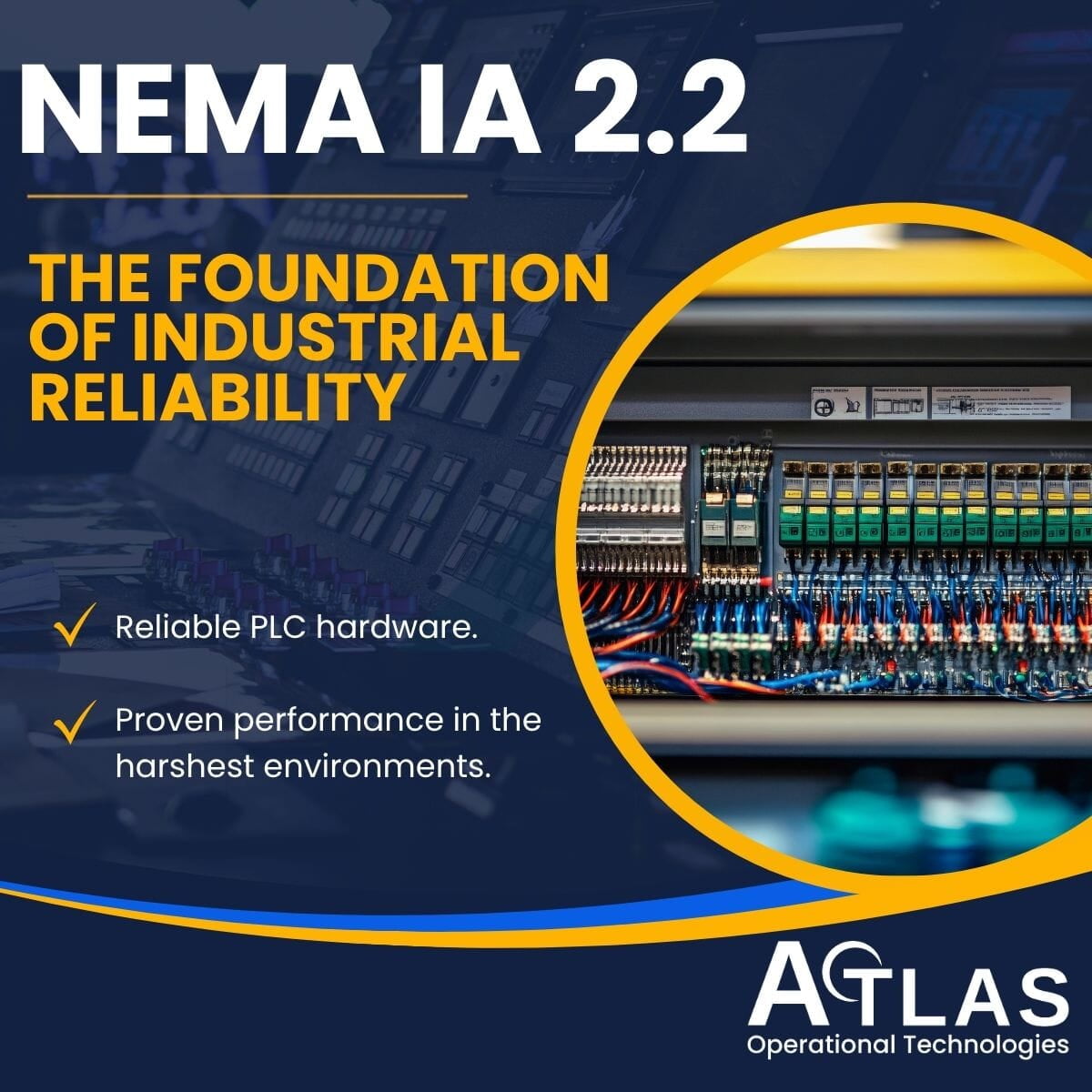
To ensure these critical computers survive the harsh realities of the plant floor, the industry relies on strict hardware standards, specifically NEMA IA 2.2 (Programmable Controllers – Equipment Requirements and Tests).
The Harsh Reality of the Industrial Plant Floor
Standard commercial electronics are designed for benign environments. If you place a commercial-grade computer inside a manufacturing plant, it will fail rapidly due to environmental stressors.
Industrial automation demands hardware built specifically for extreme conditions. Without standardization, buyers would have no way to verify if a "rugged" PLC from a vendor could actually survive their specific facility.
Thermal Stress: Commercial chips warp and fail under high heat. Industrial hardware must dissipate heat without relying on fragile, moving cooling fans.
Mechanical Vibration: Heavy machinery creates constant, low-frequency vibrations. These vibrations can easily rattle standard electrical connections loose, causing intermittent signal failure.
Electrical Noise: Massive motors and Variable Frequency Drives (VFDs) generate severe electromagnetic interference (EMI) that corrupts digital data streams.
Airborne Contaminants: Wastewater plants and refineries contain corrosive gases (like hydrogen sulfide) that rapidly eat away at exposed copper circuit boards.
NEMA IA 2.2 was established to create a unified, rigorous testing baseline, ensuring that any device labeled as an "industrial controller" can definitively withstand these exact stressors.
NEMA IA 2.2 Explained
Published by the National Electrical Manufacturers Association (NEMA), the IA 2.2 standard specifies the absolute minimum equipment requirements and test procedures for programmable controllers and their associated peripherals (like remote I/O modules and power supplies).
It provides vendors, engineers, and integrators with a common language for hardware durability. When a specification demands a NEMA IA 2.2 compliant controller, it legally forces the hardware manufacturer to prove their equipment has passed a grueling battery of physical and electrical tests.
This standard covers three critical categories of hardware validation:
Environmental Ratings: How much physical abuse the hardware can take.
Testing Procedures: The specific laboratory methods used to inflict that abuse.
Reliability Requirements: Statistical guarantees that the hardware will last over time.
Environmental Ratings (Surviving the Elements)
NEMA IA 2.2 strictly defines the environmental operating envelopes for industrial controllers. Manufacturers must publish data proving their hardware remains functional within these defined parameters.
Temperature and Humidity
Standard Operating Range: The standard establishes baseline operating temperatures, typically demanding flawless performance from 0°C to 60°C (32°F to 140°F) in non-condensing environments.
Storage and Transit: Controllers must survive even harsher extremes during shipping and storage, ensuring cold-weather transport does not crack delicate internal solder joints.
Humidity Tolerance: Hardware is tested in environments with up to 95% relative humidity to ensure moisture does not cause internal electrical arcing or rapid component corrosion.
Mechanical Shock and Vibration
Operational Vibration: PLCs undergo continuous vibration testing across various frequency sweeps to simulate mounting near heavy, vibrating equipment like industrial compressors.
Mechanical Shock: The hardware experiences sudden, high-gravity impacts (often up to 15G for 11 milliseconds) to simulate dropping during installation or sudden physical collisions.
Connector Integrity: These tests specifically verify that vibration will not cause backplane connectors, I/O terminal blocks, or communication cables to work themselves loose.
Contaminants and Corrosives
Conformal Coating Verification: For extreme environments, the standard evaluates the effectiveness of conformal coatings applied directly to the printed circuit boards.
Corrosive Gas Resistance: Hardware destined for wastewater or chemical applications is evaluated against exposure to hydrogen sulfide, chlorine, and sulfur dioxide.
Rigorous Testing Procedures (The Proving Ground)
Defining an environmental rating is only the first step. NEMA IA 2.2 dictates the exact, standardized laboratory procedures that manufacturers must use to validate those ratings. You cannot simply claim a PLC is "tough"—you must prove it via the standard.
Electrical Immunity Testing
Industrial power grids are incredibly dirty. Spikes, sags, and noise are constant threats to the 24VDC microprocessors inside a PLC.
Dielectric Withstand (Hypot): High voltage is applied across isolation barriers to guarantee that a massive field spike will not jump the gap and destroy the CPU.
Fast Transient Burst: The standard requires bombarding the PLC's power and communication lines with rapid, high-voltage electrical bursts to simulate switching transients.
Electrostatic Discharge (ESD): Laboratory technicians subject the hardware's casing and touch-points to thousands of volts of static electricity, ensuring an operator's touch won't fry the board.
Electromagnetic Compatibility (EMC)
Radiated Immunity: The PLC is placed in an anechoic chamber and blasted with radio frequencies to ensure nearby walkie-talkies or cellular towers do not cause uncommanded machine movements.
Conducted Immunity: Tests verify that noise traveling down the physical power lines from massive facility transformers will not corrupt the PLC's internal logic processing.
Power Supply Fluctuation
Voltage Dips and Interruptions: The standard tests how the PLC handles sudden brownouts. The hardware must either ride through short dips or execute a safe, controlled shutdown without corrupting memory.
Input Ripple Tolerance: Power supplies are tested to ensure they can take "dirty" AC power and convert it into the perfectly smooth DC power the microprocessor requires.
Reliability and Lifecycle Requirements
An industrial facility is built to operate for decades. Plant managers cannot afford to rip and replace their core automation hardware every three years. NEMA IA 2.2 establishes baselines for long-term hardware reliability.
Mean Time Between Failures (MTBF): Manufacturers must utilize standardized statistical models to calculate and publish the MTBF, providing engineers with a predictable hardware lifespan.
Component Derating: The standard encourages manufacturers to use internal components rated significantly higher than the intended operating load, creating a massive buffer against premature burnout.
Memory Retention: PLCs must mathematically guarantee that their internal memory (holding the critical IEC 61131-3 logic) will survive extended, multi-month power outages without battery failure.
Lifecycle Traceability: Manufacturers are held to strict revision control standards, ensuring that a replacement module bought five years later is fully backward compatible.
Synergy with UL 508A and UL 698A Fabrication
Understanding NEMA IA 2.2 is critical because the PLC does not exist in a vacuum. The controller is the beating heart of the physical control panel.
At Atlas OT, our core fabrication standards—UL 508A (Industrial Control Panels) and UL 698A (Hazardous Locations)—rely heavily on the assumption that the internal components are robust.
Thermal Management: When we engineer a UL 508A panel, we calculate the exact heat dissipation of the NEMA-rated PLC to size our external cooling fans or air conditioners perfectly.
Hazardous Area Compliance: A UL 698A panel utilizing intrinsically safe barriers is only safe if the PLC itself meets the strict dielectric isolation standards defined by NEMA IA 2.2.
Vibration Mitigation: We utilize the mechanical shock data from the NEMA testing to design our physical backpanels, ensuring DIN-rail mounted components never vibrate loose in the field.
You cannot place weak, commercial-grade hardware inside an NNNY-listed industrial control panel and expect a reliable system. Atlas OT pairs rugged NEMA hardware with certified UL enclosures to create an indestructible control architecture.
How Atlas OT Engineers Hardware Reliability
We view hardware selection as a critical engineering discipline. A poorly specified PLC will cause mysterious, intermittent faults that take weeks to diagnose and cost millions in lost production.
Here is how Atlas OT integrates NEMA IA 2.2 principles into your facility:
Environmental Matching: We understand the environmental conditions of your plant floor, noting any extremes of temperature, corrosion, vibration, etc., and supply you with the best choice of NEMA compliant hardware.
Supplier Vetting: We reject vendors who cannot provide reputable and properly certified hardware, ensuring your facility is powered only by top-tier industrial equipment. We engage with suppliers who support open platforms, availability of equipment, replacement hardware, and communicate total cost of ownership, including software and support fees.
Holistic System Testing: During Factory Acceptance Testing (FAT), we validate the hardware and software together, ensuring the PLC handles power cycling and simulated faults flawlessly.
Cyber-Physical Architecture: We pair physically robust NEMA hardware with logically robust network topologies, aligning with IEC 62443 cybersecurity standards to protect the entire system.
Secure Your Hardware Future
In operational technology, hope is not a strategy. You cannot hope your hardware survives the summer heat; you must engineer it to survive. By demanding compliance with NEMA IA 2.2, you eliminate weak links and build a facility designed for decades of uninterrupted profitability.
Get in touch with an integration firm, Atlas OT, that understands the science of survival.