
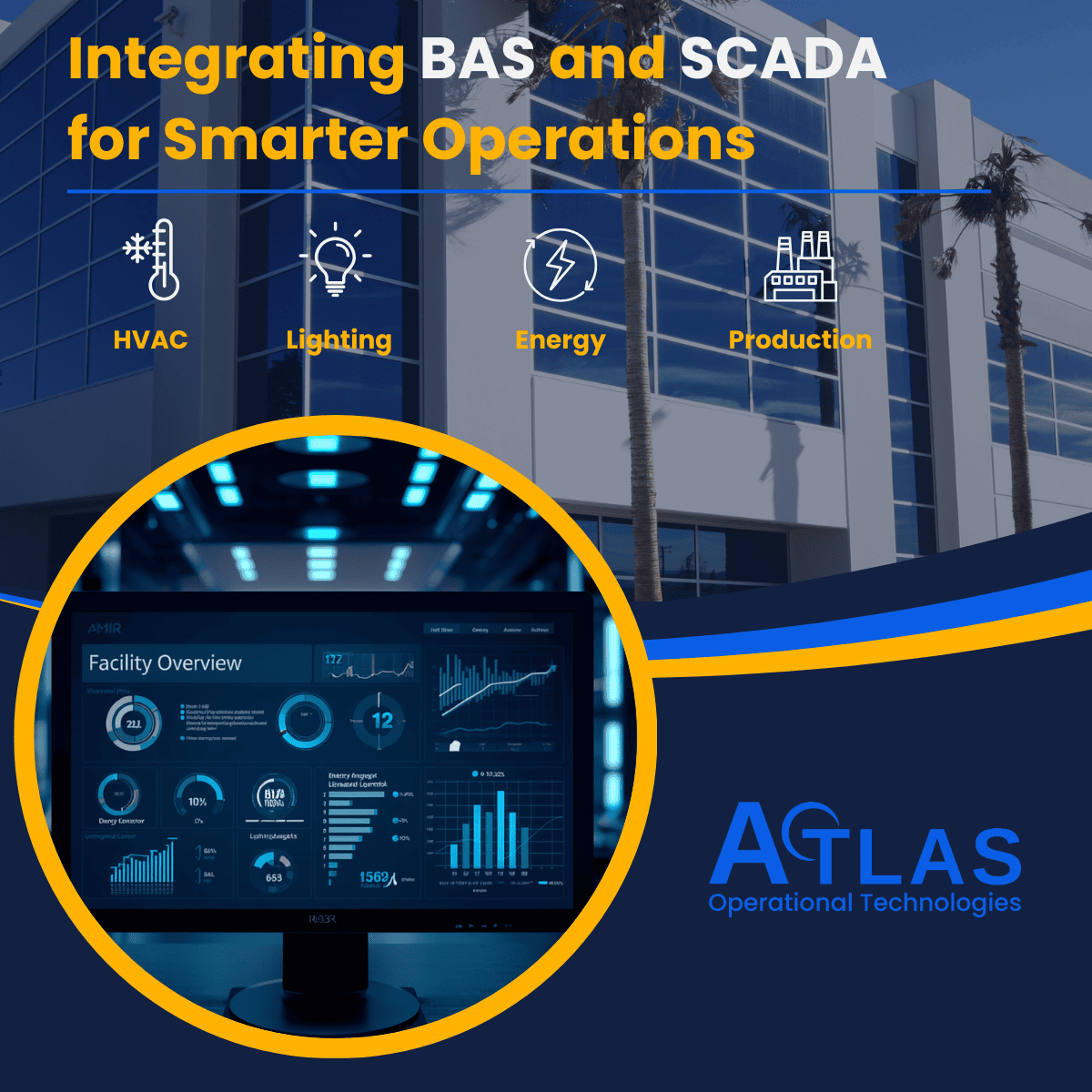
Modern commercial facilities are no longer just buildings, they are complex networks of systems that manage comfort, energy, safety, and operational efficiency. Behind every well-run office, retail space, or industrial facility is a Building Automation System (BAS) that integrates multiple technologies to streamline operations.
For facility managers and building owners, understanding how a building automation system works in commercial facilities is essential. BAS solutions are not only about convenience; they directly impact energy efficiency, occupant comfort, safety compliance, and long-term operational costs.
Atlas OT specializes in designing and implementing commercial building automation systems that balance advanced technology with practical facility needs. Their approach ensures every BAS component, from sensors to energy management systems, works seamlessly to deliver reliable and measurable results.
What Is a Building Automation System?
A Building Automation System (BAS) is a centralized platform that monitors, controls, and optimizes mechanical, electrical, and lighting systems within a commercial facility. Also sometimes referred to as Building Management Systems (BMS). Unlike traditional manual controls, a BAS uses real-time data from sensors, predictive algorithms, and automated schedules to make adjustments proactively.
In a commercial environment, BAS typically manages:
- HVAC Automation: Ensures heating, cooling, and ventilation are optimized for comfort and efficiency.
- Lighting Control: Adjusts lighting based on occupancy, schedules, or natural daylight.
- Energy Management: Monitors and optimizes energy usage to reduce costs.
- Safety Monitoring: Tracks alarms, fire detection, and system faults automatically.
By replacing manual processes with automated control, BAS improves efficiency, reduces human error, and creates a more comfortable environment for occupants.
Key Components of Commercial Building Automation Systems
A robust commercial BAS integrates multiple layers of hardware and software:
Sensors and Controllers
- Monitor temperature, humidity, air quality, and occupancy.
- Send real-time data to controllers to trigger adjustments.
HVAC Automation
- Centralized control optimizes heating, cooling, and ventilation.
- Responds dynamically to changes in occupancy and external conditions.
Lighting Control
- Automates lighting schedules and occupancy-based adjustments.
- Reduces unnecessary energy consumption while improving comfort.
Energy Management Systems
- Tracks energy consumption and identifies cost-saving opportunities.
- Generates reports for sustainable building operation.
Integration with IT Systems
- Provides dashboards, analytics, and monitoring tools for facility teams.
- Supports predictive maintenance and long-term system optimization.
How Building Automation Systems Work
Building automation systems operate through a continuous feedback loop:
- Data collection: Sensors gather environmental and operational data.
- Control logic: The system evaluates this data against predefined rules and schedules.
- System response: HVAC, lighting, or other systems adjust automatically.
Automation controls for commercial buildings allow facilities to respond dynamically to changes in occupancy, usage patterns, and external conditions. Smart building automation systems ensure consistent performance while minimizing energy waste.
Benefits of BAS in Commercial Facilities
Implementing a BAS provides several measurable advantages:
- Enhanced Comfort: Automated adjustments maintain consistent temperature, humidity, and lighting.
- Energy Efficiency: Intelligent scheduling and responsive systems reduce energy consumption and costs.
- Safety and Compliance: Monitors fire, smoke, and security systems automatically.
- Predictive Maintenance: Identifies potential system issues before downtime occurs.
- Data-Driven Insights: Provides analytics to inform operational improvements.
Commercial building automation systems help facilities operate more efficiently while maintaining a high standard of comfort and reliability.
How Building Automation Systems Work
A BAS operates using a continuous feedback loop:
- Data Collection: Sensors capture environmental and operational data.
- Control Logic Processing: The system evaluates the data using predefined rules and schedules.
- Automated Response: Systems such as HVAC, lighting, or shading adjust automatically.
This process allows facilities to respond dynamically to occupancy, energy demand, and environmental conditions. Smart building automation systems maximize efficiency while maintaining comfort, safety, and operational consistency.
By integrating automation controls for commercial buildings, facility managers gain real-time insights and actionable data for optimal decision-making.
How BAS Solutions Support Commercial Facilities
Professional BAS solutions are customized for each facility’s needs. Key services include:
- System design and architecture
- Installation and integration of sensors, controllers, and software
- Commissioning and performance validation
- Ongoing maintenance and technical support
Customized automation ensures all building systems communicate seamlessly and are easy to manage. With the right design, facilities can reduce energy waste, improve operational efficiency, and provide a better environment for occupants.
Future Trends in Building Automation
The future of BAS is evolving rapidly:
- IoT Integration: More connected devices for real-time communication.
- AI-Driven Energy Optimization: Predicts usage patterns to improve efficiency.
- Cloud-Based Monitoring: Enables remote access and predictive analytics.
- Sustainability Focus: BAS plays a key role in reducing carbon footprint.
Modern BAS platforms are becoming smarter, more adaptive, and increasingly essential for commercial facilities aiming for future-ready, sustainable operations. Atlas OT stays at the forefront of these trends to provide advanced solutions.
Integrating BAS with SCADA for Unified Facility Control
Most facilities manage building systems and production systems in separate platforms, creating operational silos, duplicate software environments, and fragmented monitoring responsibilities. Atlas OT takes a different approach.
By integrating Building Automation Systems (BAS) directly into an existing SCADA platform, organizations can consolidate critical production controls and facility infrastructure into a single, unified environment. This creates one common platform for monitoring HVAC, lighting, energy management, life safety systems, and industrial processes side by side.
Instead of switching between multiple dashboards, facilities gain:
- Centralized monitoring for both production and building systems
- Unified alarm management across all critical assets
- Simplified troubleshooting and maintenance workflows
- Reduced software redundancy and licensing costs
- Streamlined cybersecurity architecture under one control framework
This integration strategy significantly eases long-term system monitoring and maintenance by reducing platform sprawl and creating a single operational source of truth.
Atlas OT has successfully integrated building systems with production SCADA environments across industrial and commercial facilities. This unique capability allows us to serve as a single source partner for complete facility monitoring and controls, eliminating silos between OT and building infrastructure while improving visibility, reliability, and scalability.
For organizations seeking tighter operational alignment and simplified system management, this unified BAS and SCADA architecture provides a powerful competitive advantage.
Conclusion
Understanding how a building automation system works in commercial facilities empowers facility managers to improve efficiency, comfort, and operational reliability. For facilities seeking customized automation strategies, you can contact Atlas OT for expert BAS solutions to ensure long-term performance and scalability. BAS technology transforms disconnected systems into a cohesive, intelligent environment.